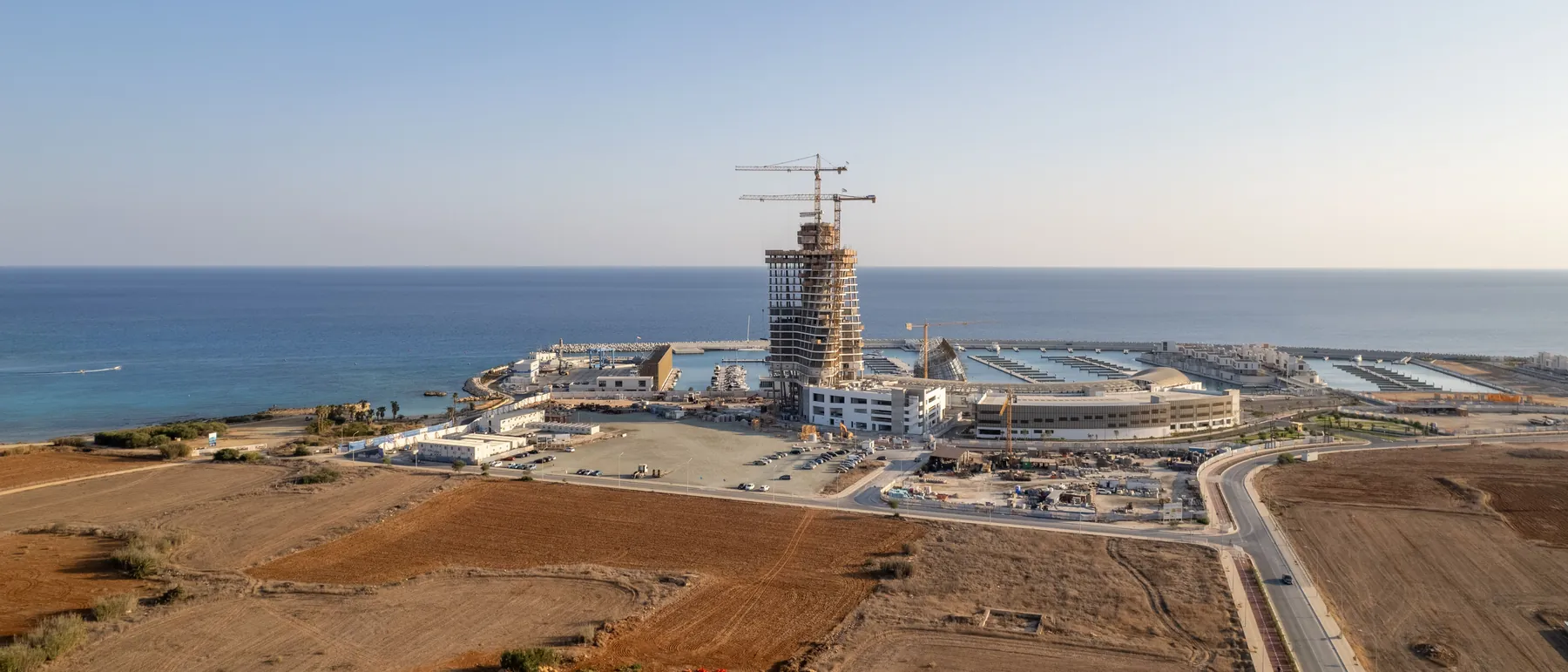
This guide is for buyers from outside the EU and EEA who are looking at a new apartment or house from a Cypriot developer, often off-plan. It covers the steps that differ for you: the permit to acquire, depositing the contract, waiting for the title deed, VAT and the separate residence question.
The short answer
Who counts as a non-EU buyer
Cap. 109, the Immovable Property Acquisition (Aliens) Law, treats anyone who is not a citizen of Cyprus as an alien, but exempts citizens of EU and EEA states and certain companies formed in another EU state; whether a company qualifies depends on where it is incorporated and established, so have your lawyer check it. Section 2 also exempts certain people of Cypriot origin and qualifying spouses. A company controlled by non-EU nationals, or a trust for their benefit, is also caught. Acquiring without permission is prohibited, and a registration made without it is void.1
In practice this covers buyers from the UK since Brexit, the Gulf, Israel, Russia, China, India and most of Asia and the Americas. If you hold a second passport from an EU state, buying under that passport removes this step.
Step 1: the permit to acquire
The permit is issued by the District Administration of the district where the property lies, under powers delegated by the Council of Ministers. The application form is COMM 145. The Ministry of Interior states that there is no fee and that processing takes between two and three weeks.1
Scroll horizontally to compare all columns.
| What you may buy | Limit |
|---|---|
| A plot for your own home | One undivided plot of up to 4,000 m²1 |
| Homes | Up to two apartments or houses, which may be at different stages of construction1 |
| Home plus business premises | One home plus a shop of up to 100 m², or one home plus an office of up to 250 m²1 |
| Couples | One joint permit; the limit applies to the couple together1 |
The application asks for the cadastral survey plan, a copy of the title deed for the land, the building permit where the unit has no separate title yet, the sale contract, floor plans, proof of your financial position, passports and, where relevant, a marriage certificate or company documents.1
Step 2: sign and deposit the contract
The permit is a condition for transfer of title, not for the contract. Cap. 109 keeps your right to sign a valid contract and deposit it while the permit is pending, so the usual order is reservation, legal review, contract, deposit, then the permit application with a copy of the contract.1
Under the Specific Performance Law, the contract must be deposited at the District Lands Office within six months of signing. The fee is EUR 50. Deposit registers a charge on the property in your favour, ranked by date, and the Land Registry will not accept a later sale contract for the same unit. If the developer fails to transfer, you can ask the court to order the transfer to you.2
The deadline normally runs from signing. Only if no seller is registered as owner at any point in those six months can you deposit within six months after the registration. Treat the deadline as firm: after it, a court may, on application, allow a late deposit of a contract still in force where it considers that fair and reasonable to protect the buyer, and the Land Registry adds a 10% surcharge to any transfer fees. For contracts signed since 12 December 2023, the developer must attach a search certificate showing any mortgage or prohibition on the land, dated within five working days of the contract.2
Step 3: from off-plan to title deed
A unit under construction cannot be registered and has no title deed. The building first needs a completion certificate from the supervising engineer and a certificate from the building authority, and only then can the Land Registry issue separate deeds. Ask the developer for a project-specific timetable for the separate title deeds.6
The Land Registry advises buyers not to pay the full price before the property is transferred to them. For a unit under construction it tells buyers to check:6
- The planning and building permits for the block, and whether the unit you are buying matches them.6
- Any mortgage on the land, shown on the search certificate. If the only registered encumbrances are mortgages or deposited sale contracts and no prohibition applies to the registered owner, the contract must be deposited with a Form A or a Form C; an additional court charge blocks this procedure, so have your lawyer check the certificate. Ask for a Form A, signed by every mortgage lender, the developer and you: once you pay the stated amount into the developer's account named in the form, the lender must release your unit and confirm payment on a Form B. Signing a Form C instead means giving up this release procedure.2
- How shares in the common property are allocated, and which common areas belong to the block.6
- The construction schedule, and what the contract says about delay.6
- A final instalment held back until the unit is transferred to you, as the Land Registry advises. We also suggest linking earlier instalments to construction stages rather than calendar dates.6
VAT and transfer fees on a new build
A first sale by a developer of a newly built home is subject to VAT. The standard rate is 19%. Where VAT is charged on the sale, no Land Registry transfer fee is due on that transfer. A resale without VAT pays transfer fees instead: 3% up to EUR 85,000, 5% to EUR 170,000 and 8% above, normally reduced by half.34
The reduced 5% rate exists, but it is narrow. It covers the first 130 m² of buildable area up to a value of EUR 350,000, and only when the whole purchase is no more than EUR 475,000 and no more than 190 m²; special area rules apply to buyers with disabilities and to families with more than three children. You must be an individual using the home as your main and permanent residence in Cyprus. The law sets no nationality condition, so a non-EU buyer who really moves to Cyprus can qualify; an investment flat or holiday home cannot. You normally file the declaration with the Tax Department before taking possession. If you stop living there within ten years, you must normally notify the Tax Department within 30 days and repay the difference proportionally; exceptions include death and a transfer to a qualifying adult child. Projects whose planning permit was granted or applied for by 31 October 2023 may fall under older transitional rules if the declaration meets their filing requirements.3
Since 1 September 2026, the sale of a building before its first occupation is subject to VAT, unless a duly completed planning permit application for it was filed before 1 May 2004; where a general or special development order makes a planning permit unnecessary, the rule applies only if a duly completed building permit application was filed after that date. The Tax Department treats a building as first occupied only after at least 18 months of real, systematic use, counted from when that use begins: a home lived in for only 12 months, or let for only 16 months since the letting began, has not reached it; short vacancies can count if systematic use continued. A home sold on before that point can therefore still carry VAT, and a qualifying buyer may claim the 5% rate on it; once first occupation has been reached, the resale carries no VAT. Confirm the VAT position of any resale with the seller in writing.7
The table uses hypothetical prices to show how the rules combine. Where only part of a home qualifies for 5%, the rest is taxed at 19%. Legal fees, bank charges and furniture are not included.3
Scroll horizontally to compare all columns.
| Example (hypothetical) | VAT | Transfer fee | Contract deposit |
|---|---|---|---|
| New apartment from a developer, EUR 320,000 net, 110 m², your main residence | 5%: EUR 16,0003 | None, VAT charged4 | EUR 502 |
| The same apartment bought to let or as a holiday home | 19%: EUR 60,8003 | None, VAT charged4 | EUR 502 |
| Resale apartment, EUR 300,000, already in use, no VAT charged | None | About EUR 8,600, roughly 2.9% of the price4 | EUR 502 |
The resale figure is EUR 2,550 plus EUR 4,250 plus EUR 10,400, halved. It assumes the Land Registry accepts the price as the basis; it can charge on market value instead, and the 50% reduction does not apply to some resales of foreclosed property. The property calculator uses a flat estimate for purchase costs, so use the bands above for a closer figure.4
Stamp duty no longer adds to the bill for documents signed from 2026: the Land Registry now asks for stamping only where a party signed before 1 January 2026. If you signed a reservation or contract in 2025, ask your lawyer how it is treated.8
Permanent residence: a separate application
Buying a home does not give you a right to live in Cyprus. The investor route, known as Regulation 6(2), is a separate application to the Migration Department with its own conditions:5
- A new home bought from a developer as a first sale, at least EUR 300,000 plus VAT; up to two units may be combined.9
- A title deed or a deposited contract, plus official payment receipts for at least EUR 300,000 excluding VAT and evidence that the money came from abroad and was paid to the seller's account at a Cypriot bank.9
- Secured income from abroad of at least EUR 50,000 a year, plus EUR 15,000 for a spouse and EUR 10,000 per minor child.5
- The permit covers the spouse and children under 18. Unmarried, financially dependent children aged 18 to 25 can apply separately if they are enrolled in tertiary education abroad when they submit their own application, with EUR 10,000 more income each.9
- The application fee is EUR 500, processing takes about two months, and the card is valid for ten years. If you live abroad, you must take up residence in Cyprus within one year of approval, and the permit lapses after two years outside Cyprus.95
Because the deposited contract counts as evidence, you can apply before completion, which matters on an off-plan purchase. You must, however, already have paid at least EUR 300,000, excluding VAT, when you apply, shown by official receipts, in one payment or several. The VAT is not part of the EUR 300,000. For a comparison with the Greek route, see Greece Golden Visa vs Cyprus permanent residency.9
A checklist before you reserve
- Instruct an independent Cypriot lawyer who acts only for you, not the developer's lawyer.
- Ask the developer for the title deed of the land, the planning and building permits, and a statement of any mortgage on the plot.6
- Confirm in writing whether the price includes VAT and at which rate, and whether you qualify for 5%.3
- Sign the contract, deposit it within six months, then apply for the permit to acquire.21
- If residence is the goal, check the developer, price and payment route against the investor criteria before you pay.9
Frequently asked questions
Can a non-EU citizen buy property in Cyprus?
Yes. Most buyers from outside the EU and EEA need a permit from the District Administration under Cap. 109; certain people of Cypriot origin, qualifying spouses and qualifying companies are exempt. The usual limit is one plot of up to 4,000 m² for a home or up to two units, and a couple shares one permit. You can sign and deposit the sale contract while the permit is pending.1
How long does the permit to acquire take?
The Ministry of Interior states two to three weeks and no fee, on a page last updated in June 2024. Allow more time if documents are missing.1
When do I get the title deed for an off-plan apartment?
Only after completion, once the engineer and the building authority have certified the building and the Land Registry has registered the unit. Ask the developer for the project-specific timetable. Until then your protection is the deposited sale contract.6
Do I pay transfer fees on a new build?
Not when VAT is charged on the sale. Transfer fees apply to sales without VAT, typically resales, at 3%, 5% and 8% per band, normally halved.4
Can a non-EU buyer get the 5% VAT rate?
The law does not exclude non-EU nationals, but the home must be your main and permanent residence in Cyprus, and the value and size caps apply. Investment and holiday homes pay 19%.3
Does buying a new build give me residency?
Not by itself. The investor permanent residence route needs a first sale from a developer of at least EUR 300,000 plus VAT, foreign income and a separate application to the Migration Department.5
Sources
- 1.CyLaw (Cyprus Bar Association legal database), Immovable Property Acquisition (Aliens) Law, Cap. 109, sections 2 and 3, Greek consolidated text. checked November 19, 2026
- Ministry of Interior, Republic of Cyprus, Purchasing property (acquisition of immovable property by aliens), page modified 1 June 2024. checked November 19, 2026
- Department of Lands and Surveys, Republic of Cyprus, Sale / exchange: required documents and fees. checked November 19, 2026
- 2.CyLaw (Cyprus Bar Association legal database), Sale of Immovable Property (Specific Performance) Law 81(I)/2011, section 3(1)(c). checked November 19, 2026
- CyLaw (Cyprus Bar Association legal database), Immovable Property (Transfer and Mortgage) Fees Law, Cap. 219, section 10 and fee schedule. checked November 19, 2026
- Department of Lands and Surveys, Republic of Cyprus, Purchase of immovable property: the importance of depositing the sale contract, June 2022. checked November 19, 2026
- Department of Lands and Surveys, Republic of Cyprus, Deposit of a sale contract: documents, Forms A and C, search certificate. checked November 19, 2026
- Department of Lands and Surveys, Republic of Cyprus, Frequently asked questions on Law 132(I)/2023 (Forms A, B and C), August 2024. checked November 19, 2026
- 3.CyLaw (Cyprus Bar Association legal database), Value Added Tax Law 95(I)/2000, section 17 and Fifth Schedule, Table C, Greek consolidated text. checked November 19, 2026
- Tax Department, Republic of Cyprus, Announcement on reduced 5% VAT declarations for the purchase or construction of a residence, 4 May 2026. checked November 19, 2026
- 5.Migration Department, Republic of Cyprus, Immigration permits for investors, 4th revision May 2023. checked November 10, 2026
- 7.Republic of Cyprus, Official Gazette (via CyLaw), VAT (Amendment of the Eighth Schedule) Order 2026, K.D.P. 103/2026 of 27 February 2026, in force 1 September 2026. checked November 19, 2026
- Tax Department, Republic of Cyprus, VAT and immovable property. checked November 19, 2026
- Tax Department, Republic of Cyprus, Circular 6/2026 on first establishment of immovable property, 11 November 2026. checked November 19, 2026
- 8.Department of Lands and Surveys, Republic of Cyprus, Sale / exchange: required documents and fees. checked November 19, 2026
- 9.Migration Department, Republic of Cyprus, Immigration permits for investors, 4th revision May 2023. checked November 19, 2026