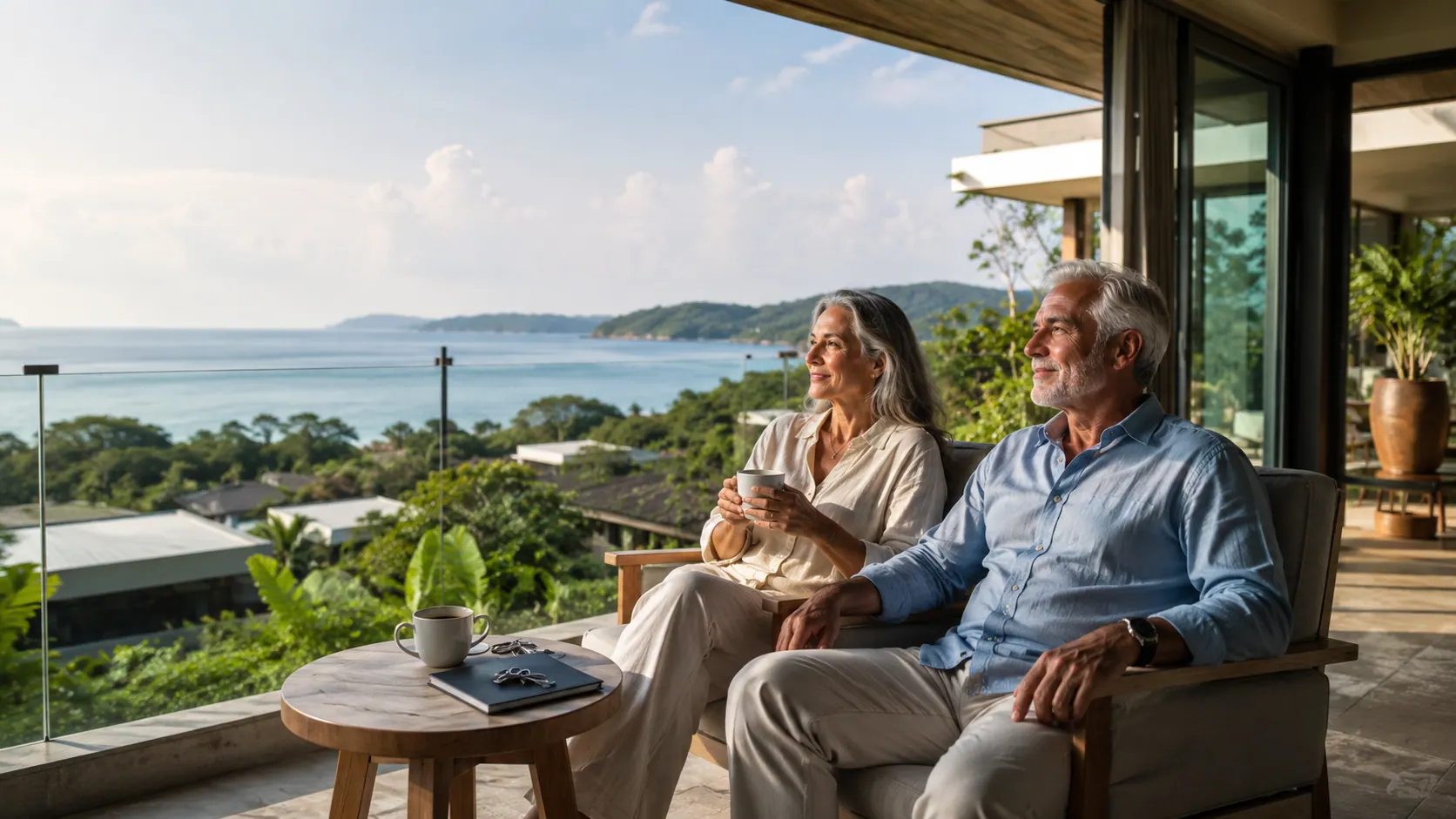
Depending on your age, nationality, income structure and property plans, you may also be able to consider the O-X visa with a 3 million THB Thai bank deposit, the LTR Wealthy Pensioner visa, or a separate property-linked long-stay route based on a qualifying real estate position from 3 million THB.
These routes are not interchangeable. A property purchase does not replace the bank deposit required for a standard retirement extension. Equally, a qualifying property does not automatically produce a visa. Each route has its own legal basis, evidence requirements, renewal structure and approval process.
This guide compares the principal financial requirements in force in 2026 and explains where the 3 million THB property route may provide a practical entry option for international buyers.
Last reviewed: 7 August 2026. Thai immigration practice can vary by application type, processing mission and local immigration office. Confirm the current filing requirements before transferring funds or committing to a property.
Thailand retirement visa financial requirements at a glance
| Route | Minimum age | Main financial test | Typical permission structure | Main limitation |
|---|---|---|---|---|
| Non-Immigrant O retirement route | 50 | 800,000 THB deposit, 65,000 THB monthly income, or an accepted combination | Initial non-immigrant stay followed by annual extensions | Financial evidence and annual renewal |
| Non-Immigrant O-A | 50 | 800,000 THB deposit, 65,000 THB monthly income, or an accepted combination | Up to one year, with later extensions possible | Insurance, medical and criminal-record requirements |
| Non-Immigrant O-X | 50 | 3 million THB in a Thai bank, or 1.8 million THB plus 1.2 million THB annual income | Five years, with a possible further five years | Limited nationalities and substantial capital commitment |
| Property-linked 3 million THB route | No retirement age stated in the cited property provisions | Qualifying purchase from 3 million THB, or specified rental or registered lease structures | Initial non-immigrant process followed by extensions generally granted for up to one year at a time | Ministry-related certification, qualifying transaction and immigration approval required |
| LTR Wealthy Pensioner | 50 | USD 80,000 passive income, or at least USD 40,000 passive income plus USD 250,000 invested in Thailand | Five years plus a possible further five years | High passive-income threshold and continuing qualification requirements |
The table is a planning summary, not an approval guarantee. The decisive rules are those applied to your application by the responsible Thai authority.
What does “Thailand retirement visa” actually mean?
Thailand does not have one single visa product officially named the “Thailand Retirement Visa”. The expression is commonly used for several immigration routes available to people aged 50 or older:
- A Non-Immigrant O visa followed by a retirement-based extension of stay in Thailand
- A Non-Immigrant O-A long-stay visa, normally applied for through a Thai embassy or consulate outside Thailand
- A Non-Immigrant O-X long-stay visa for applicants with an eligible nationality
- An LTR Wealthy Pensioner visa for retirees with substantial passive income or qualifying Thai investments
The separate 3 million THB property-linked route discussed later in this guide is different. It is not legally a retirement visa and the cited property provisions do not state a minimum retirement age. It is included because it can serve a similar long-stay objective for a buyer who is prepared to establish a qualifying property position in Thailand.
Option 1: The 800,000 THB bank deposit
The 800,000 THB deposit is the most familiar financial method for a standard retirement-based extension.
For an extension processed inside Thailand, the funds are generally expected to be held in an eligible Thai bank account in the applicant's own name. Immigration may request:
- A recent bank confirmation letter
- Bank statements covering the prescribed period
- The original bank book, where applicable
- A balance update close to the application date
- Evidence that the account belongs solely to the applicant
- Records showing the origin and transfer of the funds, where requested
For an initial O-A application filed outside Thailand, the responsible embassy or consulate may accept financial evidence from a bank in the country of application. Statement periods, certification, translations and account-format requirements can differ between missions.
The Thai Ministry of Foreign Affairs lists the O-A financial test as a deposit of at least 800,000 THB, monthly income of at least 65,000 THB, or an accepted combination reaching the required amount. See the official Non-Immigrant O-A guidance.
How long must the 800,000 THB remain in the account?
The 800,000 THB route is not a one-day balance test.
For a retirement extension, the current official guidance states that the money must generally have been deposited for at least two months before the application. The full amount must then remain in the account for three months after permission is granted. After that period, the balance must not fall below 400,000 THB during the remaining validity of the extension.
Applicants should still confirm timing with the immigration office that will process the application, particularly where an account history is unusual or the filing involves a change of status. The official Thai government summary is available under Extension of stay for retirement.
Is the 800,000 THB a government fee?
No. The money remains the applicant's property. It is not paid to the Thai government as a visa charge.
However, the balance is partly restricted by the holding rules. That creates an opportunity cost and should be considered when comparing the standard retirement route with an investment route, an LTR visa or a paid membership programme.
Option 2: Monthly income of at least 65,000 THB
Instead of maintaining the full bank deposit, an applicant may qualify by demonstrating monthly income or pension payments of at least 65,000 THB.
Potential supporting evidence includes:
- An official pension statement
- Tax assessments or government-issued income records
- Bank statements showing regular payments
- Evidence of recurring international transfers into Thailand
- An income confirmation accepted by the responsible Thai mission or immigration office
- Certified translations and legalisation where required
The accepted format can vary. Some applicants can rely on a recognised income document, while others may need to demonstrate a consistent pattern of transfers into a Thai account. Confirm three points before choosing this method:
- Whether the proposed income type is accepted
- Which documents the processing authority requires
- Whether regular remittances into Thailand must be shown
Exchange-rate movements also matter. Income that only narrowly exceeds 65,000 THB may fall below the threshold when converted. A prudent application should contain a reasonable margin.
Option 3: Combining income and savings
The official O-A criteria also recognise a combination of deposit funds and qualifying income reaching the required total.
For example, an applicant who does not hold the full 800,000 THB as a deposit may be able to combine a smaller qualifying balance with accepted annual income. The applicant must document both components and comply with any rules applied to the deposit portion.
The combination method is particularly sensitive to local documentary practice. Do not assume that any informal calculation will be accepted. Ask the responsible mission or immigration office to confirm the evidence and holding requirements before structuring the application.
Non-Immigrant O and O-A: Same headline figures, different processes
The standard Non-Immigrant O retirement route and the O-A use the same familiar headline thresholds, but the application processes are different.
Non-Immigrant O retirement route
This route commonly begins with a non-immigrant permission, followed by an application for a one-year retirement extension in Thailand. It can suit applicants who are already establishing their banking, residence and documentation in Thailand.
Typical considerations include:
- Thai bank account availability
- Timing of the 800,000 THB deposit
- Local immigration-office requirements
- Annual renewal
- Re-entry permission when leaving Thailand
- Periodic address reporting
Non-Immigrant O-A
The O-A is designed for applicants aged 50 or older who want to arrange a long-stay visa before relocating and who do not intend to work in Thailand.
In addition to the financial test, applicants generally need:
- A criminal-record certificate
- A medical certificate covering specified prohibited conditions
- Health insurance meeting the applicable O-A standard
- Evidence of residence or legal status in the country of application
- Mission-specific forms and supporting documents
Current official mission guidance commonly refers to medical insurance of at least 3 million THB or USD 100,000 per policy year for the O-A. The exact wording, insurer eligibility and required certificate should be confirmed with the mission processing the application.
That figure is not on the ministry page cited above, which asks only for a medical certificate. It comes from the long-stay insurance scheme of the Thai General Insurance Association, which states a minimum cover of USD 100,000, equivalent to 3 million baht; the older 400,000 and 40,000 baht limits appear there only for renewals of policies issued before 1 September 2022. See the long-stay insurance guidance.
The O-A can be convenient for someone arranging the move from abroad. For other applicants, the Non-Immigrant O followed by an in-country extension may be administratively more practical.
The O-X: The 3 million THB bank-deposit route
The Non-Immigrant O-X is a separate long-stay retirement visa for eligible applicants aged 50 or older.
It provides an initial visa period of five years, with the possibility of a further five years if the applicant continues to meet the conditions.
The official financial options are:
- At least 3 million THB deposited in a Thai bank, or
- At least 1.8 million THB deposited in a Thai bank plus annual income of at least 1.2 million THB
Under the second option, the bank balance must be increased to at least 3 million THB within the first year. The central Department of Consular Affairs also states that the qualifying funds must remain intact for at least the first year. After that, at least 1.5 million THB must remain in the account, and withdrawals are limited to expenditure in Thailand.
See the official Non-Immigrant O-X criteria.
Which nationalities can use the O-X?
The central Thai Department of Consular Affairs currently lists 14 eligible nationalities:
Australia, Canada, Denmark, Finland, France, Germany, Italy, Japan, the Netherlands, Norway, Sweden, Switzerland, the United Kingdom and the United States.
Applicants should verify nationality eligibility and insurance requirements with the mission handling the case. Official Thai mission pages are not always perfectly harmonised, particularly regarding the current O-X insurance wording.
When does the O-X make sense?
The O-X may suit a retiree who:
- Is at least 50 years old
- Holds an eligible passport
- Wants a longer immigration framework
- Can retain substantial capital in Thailand
- Does not need ordinary employment rights
- Accepts ongoing reporting and qualification reviews
The 3 million THB is not a fee, but the capital is materially restricted. This is the key economic difference between the O-X and the property-linked route described below.
The separate property-linked 3 million THB long-stay route
Thailand also has a separate route involving a qualifying real estate position from 3 million THB. It is often described commercially as a “Thailand 3 Million Baht Visa”, but that label can be misleading.
Legally, this is not the O-X and not a standard retirement visa. Immigration Orders 237/2568 and 238/2568, effective from 1 October 2025, create criteria for non-immigrant status and extensions for qualifying supporters of long-stay tourism.
The cited property provisions do not state a minimum retirement age or a separate monthly-income test. That makes the pathway potentially relevant to younger buyers, early retirees and international investors who do not meet the standard retirement-age requirement.
The provisions recognise more than one structure: a qualifying condominium purchase from 3 million THB, a qualifying rental from 85,000 THB per month, and a registered lease running longer than three years whose advance payments reach the same threshold.
Both orders are Thai-language documents. The copies linked here sit on the website of a private immigration firm rather than on a government domain, so treat them as a convenience copy and not as the official record:
- Immigration Order 237/2568: visa issuance and change-of-category criteria
- Immigration Order 238/2568: extension-of-stay criteria

Ministry-related certification is essential
A qualifying property, rental or lease is not enough on its own.
The application must include the required certification and request connected to Thailand's Ministry of Tourism and Sports or an authorised party. This documentation links the applicant's qualifying transaction to the long-stay tourism framework.
The certification matters for a second reason. Without it, the threshold that applies is not 3 million THB but the 10 million THB investment level of the general investor route.
The final decision remains with the competent Thai authorities.
Is the 3 million THB property route an easy entry option?
For the right buyer, it can be one of the more straightforward capital-based pathways.
A person who already intends to buy a suitable completed Thai condominium may be able to use the same capital to:
- Acquire a real asset
- Establish a potential basis for renewable long-stay permission
That can be economically more appealing than leaving 3 million THB in a restricted bank deposit under the O-X. It may also be relevant to someone below 50 because the cited property criteria do not contain the retirement-age threshold used by the O, O-A and O-X routes.
However, “straightforward” does not mean automatic or risk-free.
A poor investment does not become a good one because it may support a visa application. The property should make commercial sense independently of the immigration benefit.
That route has a guide of its own, where the purchase, the leasehold, the rental, the family rules and the renewals are set out in full: Thailand 3 Million Baht Visa: Property and Long-Stay Route.
LTR Wealthy Pensioner financial requirements
The Long-Term Resident programme offers a higher-tier route for retirees with substantial passive income.
The Wealthy Pensioner category requires the applicant to be at least 50 years old and meet one of two tests:
- Passive or unearned income of at least USD 80,000 per year, or
- Passive or unearned income of at least USD 40,000 per year plus at least USD 250,000 invested in qualifying Thai assets
Qualifying investments may include:
- Thai government bonds meeting the programme rules
- Direct investment in qualifying Thai companies
- Thai property owned in the applicant's name
Where property is jointly owned, only the applicant's documented proportional interest is counted. The investment must already exist before the application.
The current criteria are published by Thailand's Board of Investment on the official LTR portal.
What income counts for the LTR Wealthy Pensioner route?
The BOI requires passive or unearned income. Potentially qualifying sources include:
- Pension income
- Rental income
- Dividends
- Interest
- Royalties
- Realised capital gains
- Other properly documented passive income
Salary, employment remuneration, director's fees and self-employment income are not accepted for the Wealthy Pensioner income test.
This distinction is important for business owners and consultants. A high total income does not qualify when most of it is active earnings.
LTR health-insurance or deposit requirement
An applicant generally needs one of the following:
- Health insurance with at least USD 50,000 in qualifying coverage
- Eligible Thai social-security protection
- A bank deposit of at least USD 100,000 held for at least 12 months
The complete official document list is available in the BOI's Wealthy Pensioner requirements.
LTR duration and practical advantages
The LTR provides an initial five-year permission, with a possible further five years if the conditions remain satisfied.
The BOI lists benefits including:
- Annual immigration reporting instead of ordinary 90-day reporting
- Multiple-entry permission
- No separate re-entry permit
- Access to relevant one-stop-service facilitation
- A specific exemption framework for overseas income
Tax treatment remains fact-specific. Anyone relying on the LTR's tax position should obtain advice based on residence, remittance, income source and treaty exposure.
Which route is likely to fit which applicant?
Standard Non-O retirement extension
Potentially suitable when you:
- Are at least 50
- Can maintain 800,000 THB in a Thai bank, or prove 65,000 THB monthly income
- Accept annual renewals
- Want the lowest mainstream financial threshold
Non-Immigrant O-A
Potentially suitable when you:
- Are at least 50
- Want to arrange the initial long stay before moving
- Can satisfy the insurance, medical and criminal-record requirements
- Prefer an overseas application process
Non-Immigrant O-X
Potentially suitable when you:
- Are at least 50
- Hold an eligible nationality
- Want a five-year framework
- Can retain 3 million THB in Thailand
- Prefer a bank-based qualification rather than a property purchase
Property-linked 3 million THB route
Potentially suitable when you:
- Intend to purchase a completed Thai condominium anyway
- Prefer capital in a real asset rather than a restricted bank account
- Are below 50 or do not wish to rely on retirement-income evidence
- Accept annual extensions and programme documentation
- Obtain written pre-clearance on the transaction and certification process
LTR Wealthy Pensioner
Potentially suitable when you:
- Are at least 50
- Receive substantial documented passive income
- Want a longer-term immigration structure
- Value annual reporting and multiple-entry convenience
- Can maintain the programme's income, investment and insurance conditions
Financial proof checklist
Depending on the route, prepare:
- Bank statements for the required period
- A current bank confirmation letter
- An updated bank book where applicable
- Evidence that the account is in the applicant's name
- Pension statements
- Tax returns or official income assessments
- Records of recurring international transfers
- Certified translations and legalisation where required
- Source-of-funds evidence
- Foreign-exchange transfer documentation
- Property purchase agreement
- Payment receipts
- Registered condominium ownership documents
- Registered lease documents
- Ministry or authorised-operator certification
- Evidence that the qualifying balance, investment or property remains in place
Names, passport numbers, account holders, transfer references and property documents must be consistent throughout the file.

Common financial mistakes
Transferring the 800,000 THB too late
The pre-application holding period matters. A last-minute transfer can prevent an otherwise eligible applicant from filing on time.
Letting the account fall below the required amount
The deposit rules continue after approval. Falling below the applicable balance can jeopardise the next extension.
Assuming property replaces the standard 800,000 THB requirement
It does not. Property only counts where the chosen route expressly recognises it, such as the separate property-linked framework or the qualifying investment component of the LTR programme.
Using active salary for an LTR Wealthy Pensioner application
The LTR Wealthy Pensioner income test is based on passive or unearned income, not ordinary salary or self-employment income.
Buying an off-plan unit for an immediate property-linked application
A reservation contract is not registered ownership. The property route requires the correct completed transaction and supporting ownership documents.
Believing that a 3 million THB purchase guarantees approval
It does not. The transaction, certification, documentation and applicant must all satisfy the relevant requirements, and approval remains discretionary.
Ignoring foreign-exchange risk
An overseas pension only slightly above the threshold can fall below it after conversion.
Assuming one financial position covers two principal applicants
A married couple should not assume that one 800,000 THB balance supports two independent retirement applications. Each principal applicant may need to qualify separately, or one spouse may need to use a dependent structure where available.
Frequently asked questions
How much money do I need for a Thailand retirement visa in 2026?
For the standard retirement routes, the core financial test is generally 800,000 THB in qualifying savings, 65,000 THB in accepted monthly income, or an accepted combination reaching the required total. Other routes have higher thresholds, including 3 million THB for the O-X bank option and USD 80,000 passive income for the full LTR Wealthy Pensioner income route.
Can I retire in Thailand with 500,000 THB?
A 500,000 THB balance is not enough for the standard deposit method on its own. It may form part of an accepted combination with qualifying income, subject to the evidence rules applied to your case.
Can Thai property count towards the 800,000 THB retirement requirement?
No. Owning a condominium or villa does not replace the standard 800,000 THB bank requirement. Property may count under a separate route, such as the property-linked 3 million THB framework or the USD 250,000 Thai investment component of an LTR Wealthy Pensioner application.
Are the 800,000 THB and 65,000 THB thresholds different by nationality?
The headline financial thresholds are broadly the same. The evidence format can differ according to the embassy, consulate or immigration office handling the case. The O-X is different because it is restricted to specified nationalities.
Can a married couple use one 800,000 THB deposit?
Do not assume so. Two principal retirement applicants may each need to qualify independently. Depending on the route, one spouse may instead apply as a dependent or accompanying family member.
Does Dubai or overseas rental income count for the LTR Wealthy Pensioner visa?
Rental income is among the passive-income types recognised by the BOI, provided it is properly documented and meets the programme's annual threshold.
Can I work in Thailand on a retirement visa?
The standard retirement routes do not provide ordinary employment rights. The property-linked route should not be treated as work authorisation either. Anyone intending to work or operate a business in Thailand should obtain route-specific legal advice.
Final assessment
For most applicants aged 50 or older, the standard choice remains the most accessible:
- 800,000 THB in qualifying savings
- 65,000 THB in accepted monthly income
- Or an accepted combination
The O-X provides a longer framework but requires significantly more capital and an eligible nationality. The LTR Wealthy Pensioner offers stronger immigration convenience, but its passive-income threshold is substantially higher.
The separate property-linked 3 million THB route occupies a different position. For a buyer who already intends to acquire a qualifying completed condominium, it can combine a real estate investment with a potential basis for renewable long-stay permission. It may also be relevant below age 50.
The correct order is essential: do not purchase first and ask about eligibility later. Confirm the immigration route, transaction eligibility, certification process and property quality before committing capital.
For a wider relocation overview, see Retiring in Thailand in 2026.
How LION & LAND can help
LION & LAND helps international buyers compare Thai property markets, assess suitable projects and coordinate the real estate side of a cross-border relocation.
For a property-linked long-stay strategy, our role can include:
- Identifying completed condominium projects that may fit the target transaction profile
- Assessing location, pricing, rental demand and resale liquidity
- Coordinating independent legal due diligence
- Organising the property transfer and documentary workflow
- Connecting the buyer with qualified Thai immigration and tax specialists
- Keeping the property decision separate from any unverified visa promise
Speak with LION & LAND about a Thailand property strategy.
Important: LION & LAND does not provide legal, immigration or tax advice and cannot guarantee visa approval. Eligibility, documentation and the current implementation of any immigration route must be confirmed with qualified Thai professionals and the responsible authorities before capital is committed.
Official and primary sources
- Thailand Ministry of Foreign Affairs: Non-Immigrant O-A
- Thai General Insurance Association: long-stay insurance scheme for the O-A
- Royal Thai Government: retirement extension financial conditions
- Thailand Department of Consular Affairs: Non-Immigrant O-X
- Thailand Immigration Order 237/2568 (Thai original, convenience copy on a private site)
- Thailand Immigration Order 238/2568 (Thai original, convenience copy on a private site)
- Thailand Board of Investment: LTR programme
- BOI: Wealthy Pensioner required documents