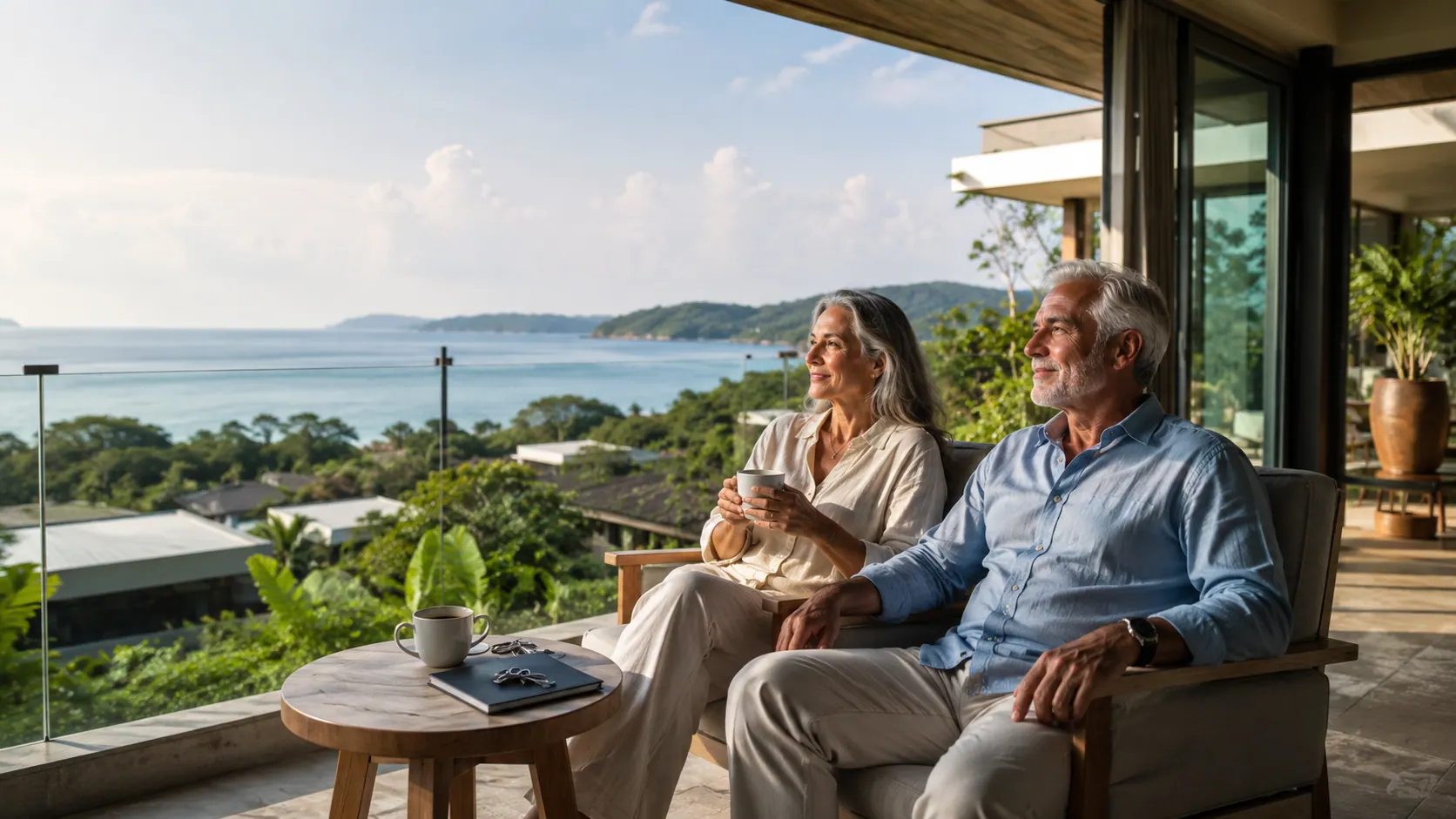
The most important points in 60 seconds
- Four realistic long-stay routes: the O-A and the O-X from age 50, the Thailand Privilege membership, and the LTR visa for higher income, pension or investment. A separate Non-Immigrant O route can be extended from inside Thailand.
- O-A financial test: 800,000 THB in a Thai bank account or 65,000 THB monthly income, or an accepted combination. Renewed annually, and an extension is assessed rather than granted automatically.
- Property: a foreigner can own a condominium unit freehold within a building's 49 percent foreign quota. Land is generally closed to foreign individuals, so villas are usually held on a registered lease of up to 30 years.
- Tax: 180 days or more in a calendar year makes you a Thai tax resident. Since 1 January 2024 foreign income earned while resident is in charge when it is remitted to Thailand, subject to the applicable double taxation agreement.
- Health insurance is a visa condition, and the minimums differ: 3,000,000 THB cover for the O-A, 40,000 THB outpatient and 400,000 THB inpatient for the O-X.
- Monthly cost of living for a comfortable retirement runs roughly 50,000 THB in Chiang Mai to 150,000 THB in Phuket, depending on housing and healthcare standard.
- Buying property does not by itself create permanent residence or citizenship. Every route here is a permission to stay that has to be maintained.
Why More International Buyers Want to Retire in Thailand
What makes retiring in Thailand particularly attractive for 2026 is that the visa and investment landscape has matured significantly. The Thailand LTR visa now offers a 10-year pathway with real tax advantages. The Thailand Privilege program (formerly known as the Thailand Elite visa) provides flexible 5 to 20-year residency options. And the traditional Thailand retirement visa routes remain accessible for buyers over 50 with modest financial requirements.
The key is approaching it with the right preparation. Thailand rewards buyers who plan ahead, understand the rules, and work with the right advisors. The lifestyle is genuinely excellent, and the legal and tax framework is navigable when you have the right guidance from the start.
Thailand Retirement Visa and Long-Stay Options for 2026
As of early 2026, Thailand offers several well-established visa pathways for retirees and long-stay buyers. The right route depends on your age, nationality, income, and how long you plan to stay. Here is how the main Thailand retirement visa options compare, and what the requirements currently involve.
| Route | Minimum age | Financial test | Duration | Health insurance | Tax on foreign income |
|---|---|---|---|---|---|
| O-A retirement visa | 50 | 800,000 THB in a Thai bank or 65,000 THB monthly income, or a combination | 1 year, renewed annually | 3,000,000 THB cover required | Remittance rules apply from 180 days of presence |
| O-X (14 nationalities) | 50 | 3,000,000 THB in a Thai bank, or 1,800,000 THB plus 1,200,000 THB annual income | Up to 10 years (5+5) | 40,000 THB outpatient and 400,000 THB inpatient | Remittance rules apply from 180 days of presence |
| Thailand Longstay (3M baht property route) | None | THB 3,000,000 condo purchase, qualifying lease over THB 3,060,000, or rent from THB 85,000 per month | 90 days, extendable to 12-15 months, renewable annually | Confirm current requirements before applying | Remittance rules apply from 180 days of presence |
| LTR Wealthy Pensioner | 50 | USD 80,000 annual passive income, or USD 40,000-80,000 plus USD 250,000 invested in Thailand | 10 years (5+5) | Required per current BOI terms | Exempt on foreign-sourced income |
| LTR Wealthy Global Citizen | None | USD 1,000,000 net worth plus USD 500,000 invested in Thailand | 10 years (5+5) | Required per current BOI terms | Exempt on foreign-sourced income |
| Thailand Privilege (membership) | None | Membership fee from THB 650,000 (Bronze, until 30 September 2026) | 5 to 20 years by tier | Not a programme condition | No special treatment; remittance rules apply from 180 days |
Those figures are the entry test, not the whole picture. How long the money has to sit in the account, which income counts, what an accepted combination looks like and which documents each route wants are set out separately in Thailand retirement visa financial requirements.
Thailand Retirement Visa: O-A Visa Requirements
The O-A requires you to be 50 or older, with either 800,000 Thai Baht in a Thai bank account (approximately USD 22,000-24,000) or monthly income of at least 65,000 Thai Baht (approximately USD 1,800-2,100), or an accepted combination. It is applied for from outside Thailand and renews annually. The financial evidence accepted for the first application and for a later extension inside Thailand is not identical, and an extension is assessed by Immigration rather than granted automatically, so both should be confirmed with the responsible Thai embassy and the local immigration office. There is also a separate Non-Immigrant O retirement route, which can begin with a shorter initial permission and then be extended inside Thailand on comparable financial thresholds. It often suits people who are already in the country.
O-X Visa: Thailand's 10-Year Retirement Visa for 14 Nationalities
The O-X offers a longer commitment for those who want more stability. Per the Thai Ministry of Foreign Affairs, it requires 3 million Thai Baht in a Thai bank account, or a combination of 1.8 million Thai Baht in a Thai bank plus annual income of at least 1.2 million Thai Baht. One thing to note: the O-X is currently available to nationals of 14 countries only, Japan, Australia, Denmark, Finland, France, Germany, Italy, Netherlands, Norway, Sweden, Switzerland, United Kingdom, Canada, and the United States. If your nationality is on this list, it offers a solid 10-year framework for retirement in Thailand.
Thailand Longstay Visa: The 3 Million Baht Property Investment Route
Introduced through Immigration Orders 237/2568 and 238/2568 in October 2025, the Thailand Longstay Visa is a route that major Thai developers including Sansiri have been actively promoting to international buyers. It directly links property investment to annual long-stay rights, and it has no age restriction, which sets it apart from the O-A and O-X routes entirely. The route has moved from paper to practice during 2026: the first 90-day permits were issued in spring, and practitioner reports as of August 2026 describe the first 12-month extensions being granted. Processing practice still varies by immigration office, so current timelines should be confirmed with an immigration specialist before applying.
The qualifying threshold is THB 3,000,000, achievable through three routes: purchasing a freehold condominium unit at or above that value, entering a registered long-term lease with a total contract value exceeding THB 3,060,000, or committing to a rental agreement at a minimum of THB 85,000 per month. The rental route requires three months of advance rent for the initial application and 12 months paid in advance for annual renewals. No income proof is required under any route, the property or rental commitment itself is the qualifying basis.
The initial stay is typically 90 days, extendable to 12-15 months and renewable annually. It is a practical, accessible route for buyers who want annual long-stay rights tied directly to a real estate position, without the financial thresholds required for LTR qualification. Exact processing procedures may still vary by immigration office, so we recommend verifying current status before applying. For a detailed breakdown, see our dedicated guide: Thailand 3 Million Baht Visa Explained.
Thailand LTR Visa for Wealthy Pensioners
Thailand's LTR visa is the premium option for affluent retirees. Requirements include age 50 or older and annual passive income of at least USD 80,000, or USD 40,000-80,000 combined with USD 250,000 invested in qualifying Thai assets such as government bonds, direct investment, or Thai property. The Thailand LTR visa is valid for 10 years (5+5), includes exemption from Thai personal income tax on foreign-sourced income, and reduces immigration reporting from every 90 days to once per year.
Thailand LTR Visa for Wealthy Global Citizens (The Investment Route)
This is one of the most significant developments in Thailand's visa landscape, and the closest Thailand comes to what many search for as a "Thailand investment visa" or "Thailand golden visa." Following a major reform in February 2025, the previous USD 80,000 annual income requirement was removed entirely. Today, according to the Thailand Board of Investment, which administers the scheme, you qualify on personal net worth of at least USD 1 million combined with a minimum USD 500,000 investment in Thailand.
The investment can take several forms: Thai government bonds with at least five years remaining maturity, direct investment in Thai-registered companies, Thai real estate, or venture capital companies registered with Thailand's SEC. The visa covers 10 years and includes tax exemption on foreign-sourced income. Dependants are capped by the Board of Investment at four in total, which is the spouse and children under 20 counted together, not four children in addition to a spouse. For international investors who want long-term Thai residency tied to a real asset position, this is the most flexible route available.
Thailand Privilege Visa: The Long-Stay Option Many Search as "Thailand Golden Visa"
For buyers who want a long stay without complex financial qualification, the Thailand Privilege program (formerly the Thailand Elite visa) offers 5 to 20-year packages. On the operator's published fee table the tiers run Bronze at THB 650,000 for 5 years, Gold at THB 900,000 for 5 years, Platinum at THB 1,500,000 for 10 years, Diamond at THB 2,500,000 for 15 years and Reserve at THB 5,000,000 for 20 years, for the main applicant. Gold admits the member only; a spouse or children can be added from Platinum upwards. It includes airport fast-track, concierge services and multiple-entry privileges. It provides no tax benefits. It generally avoids the annual extension process for the term of the membership, although immigration reporting and other compliance obligations continue to apply.
Retiring in Thailand from Dubai and the UAE
Retiring in Thailand from Dubai or elsewhere in the UAE is one of the most common versions of this move, and the first thing to understand is that it is a move between two systems rather than a transfer between them. Nothing you hold in the UAE counts toward a Thai application. The Thai financial test has to be met again on Thai terms, and the tax position changes materially the moment you become Thai tax resident.
The reason the route is so well travelled is structural. A large share of the Gulf's foreign workforce reaches retirement age on an employer-sponsored residence visa that ends when the employment does. The UAE does have its own retirement route: per the UAE government portal, a retired resident aged 55 or over with at least 15 years of work inside or outside the country can apply for a five-year renewable residence permit, provided one of the financial conditions is met, property in the UAE of at least AED 1,000,000, savings of at least AED 1,000,000, or an annual income of at least AED 180,000. Those are real thresholds, and not everyone who has spent a career in the Gulf clears them. The conditions are also revised from time to time, so they should be confirmed with the ICP or with the GDRFA in Dubai before anyone plans around them. For those who do not qualify, or who simply prefer the trade, Thailand is a short direct flight away, with a lower cost base and a private hospital sector Gulf residents already recognise.
How a UAE Resident Applies for a Thai Retirement Visa
The O-A is applied for from outside Thailand, so the application is made while you are still resident in the UAE. The Thai Ministry of Foreign Affairs sets the qualification as having the nationality of, or permanent residence in, the country where the application is submitted, and states that applications may be submitted at the Royal Thai embassy or consulate-general in the applicant's home or residence country. In practice that usually means a UAE resident applies through the mission covering the UAE, the Royal Thai Embassy in Abu Dhabi, rather than in the country of their passport. Since 1 January 2025, applications from the UAE are filed online through the Thai e-Visa portal rather than in person at the embassy or at the consulate-general in Dubai. Whether a UAE residence visa satisfies the residence limb of that qualification is a decision for the mission and not for the applicant, so confirm your own position with the responsible embassy before you set a departure date around it.
What Does Not Transfer from the UAE
UAE residency, the Emirates ID, a UAE bank relationship and an end-of-service gratuity carry no weight in a Thai application. They are not recognised, not counted and not converted. The Thai test is met in Thailand or not at all: for the O-A that is 800,000 THB in a Thai bank account, or 65,000 THB in monthly income evidenced as the mission requires, or an accepted combination of the two. Opening and funding a Thai bank account is therefore part of the preparation rather than an afterthought, and it is the step most likely to set the timetable. A gratuity paid out in Dubai is simply capital, useful for meeting the deposit test, but only once it sits in the right account under the right name.
The Tax Change Is the Largest Single Difference
The biggest change is tax. The UAE levies no personal income tax. Thailand does, and the trigger is presence: from 180 days in a calendar year you are a Thai tax resident, and since 1 January 2024 foreign income earned while resident is in charge when it is remitted to Thailand. The tax section of this guide sets out the 180-day rule, the Section 41 remittance position and the LTR exemption in full. The point for someone leaving the UAE is that a zero-tax base is precisely what is being given up, and that it should be modelled before the move rather than after. The calendar year you arrive in decides whether your first year in Thailand is a resident year at all, and that turns on the arrival date, not on intent.
Thailand and the UAE do have a double taxation agreement; the UAE appears among Thailand's treaty partners listed by the Thai Revenue Department. It is worth less to a retiree than it sounds. A treaty allocates taxing rights between two systems, and the UAE side has no personal income tax on pension or investment income to allocate away. For most people leaving the UAE, the treaty that actually governs a pension is the one between Thailand and the country the pension is paid from, which is usually the country of citizenship rather than the Gulf.
How the Monthly Numbers Compare
On the Thai side this guide already gives the planning ranges for a comfortable single-person lifestyle including rent: roughly 50,000 to 80,000 THB a month in Chiang Mai, 60,000 to 100,000 THB in Hua Hin, 70,000 to 120,000 THB in Bangkok and 80,000 to 150,000 THB in Phuket. The useful comparison is not against a published Dubai average but against your own current outgoings, because a UAE household budget is dominated by rent and, where children are involved, school fees, and those vary more between two families in the same building than they do between cities. Take twelve months of UAE statements, strip out what will not follow you, and set the remainder against the range for the city you are considering. One structural difference is worth naming: UAE rent is commonly paid in advance in a small number of cheques covering the year, while Thai rent is monthly, which changes how much cash you need to hold rather than how much you spend.
Two pages here go further. Our UAE market page covers the Gulf side of the decision, including what a departing resident may want to keep there. And if you are leaving the UAE before 50, the property-linked route has no age limit at all: see Thailand 3 Million Baht Visa Explained.
Can Foreigners Buy Property in Thailand? Clear Routes for International Buyers
Can Foreigners Buy a Condo in Thailand? Freehold Ownership Explained
Yes, foreigners can own Thai condominium units outright, in their own name. The rule, set by the Condominium Act, is straightforward: up to 49% of the total sellable floor area in any registered condominium building can be held by foreign owners. Before purchasing, you confirm the available quota with the building's juristic person, and your purchase is registered at the Land Office.
There is one practical requirement to be aware of when buying property in Thailand as a foreigner: purchase funds must be transferred from abroad in foreign currency and converted to Thai Baht by a licensed Thai bank, which issues a Foreign Exchange Transaction Form (FET). This form is needed for Land Office registration. As long as the remittance trail is clean, the process is well-established and routinely handled.
Thailand's condominium market offers strong value for retirees, particularly in established locations like Bangkok, Phuket, Hua Hin, and Chiang Mai, with quality developments from reputable Thai developers at prices well below equivalent units in Dubai, London, or Singapore.
Can Foreigners Buy Villas in Thailand? Leasehold Options
Foreign individuals generally cannot own land directly in Thailand, outside narrow statutory and investment-related exceptions that rarely apply to a retirement buyer. Long-term leaseholds of up to 30 years are available and can be registered at the Land Office. Many international buyers use this structure for villas and houses when retiring in Thailand. It is worth noting that lease renewal beyond 30 years depends on the terms negotiated with the landowner, so working with experienced legal counsel at the outset matters. For the full ownership picture, including the transfer process, taxes and the structures that hold up legally, see our guide to buying property in Thailand as a foreigner.
An important context point for 2026: Thai authorities have significantly stepped up enforcement against nominee company structures used to circumvent land ownership restrictions. More than 46,000 companies have been flagged for review. A purchase that looks legitimate on the surface is not automatically outside the scope of this: the company structure, the source of funds, the beneficial ownership and the contract terms all need checking by qualified local counsel before you commit. Any advisor proposing a nominee arrangement should be avoided.
Investment-Linked Property Under the Thailand LTR Visa
For buyers entering through the LTR Wealthy Global Citizen route, Thai real estate counts toward the USD 500,000 investment threshold. This means your property purchase and your visa qualification can work together, a meaningful advantage for those planning to hold Thailand property for retirees as part of a broader cross-border portfolio.

Thailand Retirement Tax Guide: Pensions, Remittances and Tax Residency
Thailand Tax Residency and the 180-Day Rule
Under the Thai Revenue Code, an individual present in Thailand for 180 days or more in a calendar year is treated as a Thai tax resident. Below that threshold you are generally treated as non-resident and taxed on relevant Thai-source income rather than on foreign income. The day count does not settle the question on its own. How foreign income is treated depends on when it arose, whether it is remitted to Thailand, and what the applicable double taxation agreement provides. Since 1 January 2024 the Revenue Department's published position brings foreign income earned while Thai tax resident into charge when it is remitted to Thailand. Anyone splitting the year between Thailand and another base should have this assessed rather than plan around the number of days alone.
Section 41 and Foreign Income Remitted to Thailand
For those who do become Thai tax residents (180+ days), the key development is the January 2024 reinterpretation of Section 41 of the Revenue Code. Under this updated interpretation, foreign-sourced income earned from 1 January 2024 onward becomes taxable in Thailand when remitted into the country. Income earned before 1 January 2024 remains exempt, even if remitted later.
Do You Pay Tax on Pension Income in Thailand?
The practical impact depends heavily on your country of origin and the applicable double taxation agreement (DTA). US retirees receiving Social Security benefit from strong treaty protection, Article 20 of the US-Thailand treaty gives the United States exclusive taxing rights. UK retirees should note that the 1981 UK-Thailand DTA does not contain a specific pensions article, so specialist advice is important to confirm your position.
Thailand LTR Visa Tax Benefits
This is the critical distinction: while O-A and O-X visa holders who become Thai tax residents (180+ days) are subject to the Section 41 remittance rules, Thailand LTR visa holders are specifically exempt from Thai personal income tax on foreign-sourced income. This exemption is built into the LTR program and is one of the most commercially important differences between the routes. If tax on foreign pension or investment income is a significant concern for your retirement planning, the LTR visa is the route to examine first.
In all cases, cross-border tax planning is part of a well-prepared retirement move to Thailand, and it is something we help clients coordinate with qualified cross-border tax specialists as part of the overall advisory process.
Healthcare in Thailand for Retirees: Insurance, Hospitals and Long-Term Planning
Thailand's private healthcare system is genuinely world-class. Hospitals like Bumrungrad International and Bangkok Hospital hold JCI accreditation and offer care comparable to the best facilities in North America and Europe, at a fraction of the cost. This is not marketing language; it is one of the primary reasons medical tourism to Thailand has grown consistently for two decades. For retirees moving to Thailand, the quality of private hospitals is a genuine advantage.
Retirees need health insurance from an insurer approved by Thailand's Office of Insurance Commission, and the two long-stay visas do not ask for the same cover. The O-X requires at least 40,000 THB outpatient and 400,000 THB inpatient per policy year. The O-A has required 3,000,000 THB since the Ministry of Public Health raised it on 1 October 2021, roughly eight times the older figure, so a policy bought to the O-X minimum will not support an O-A application. The important thing is to plan insurance for retirees in Thailand in advance, especially past age 70-75 when premiums increase and some providers apply entry limits. Entry age limits, renewal guarantees, exclusions for pre-existing conditions and waiting periods differ sharply between insurers and between products from the same insurer, so the terms that matter have to be confirmed against the specific policy on offer rather than the provider's name.
With the right insurance in place, Thailand's healthcare system is a genuine asset, not a concern.
Cost of Living in Thailand for Retirees in 2026
One of Thailand's strongest draws is genuine value for money. Here are the best places to retire in Thailand with monthly planning ranges for a comfortable single-person lifestyle, including rent, utilities, food, transport, and day-to-day spending:
Cost to Retire in Chiang Mai
50,000-80,000 THB per month. Thailand's northern cultural hub offers the most affordable retirement lifestyle in the country. Cooler climate, a well-established expat community, excellent food, and easy access to hospitals and domestic flights. Chiang Mai remains one of the best places to live in Thailand for retirees on a moderate budget.
Cost to Retire in Hua Hin
60,000-100,000 THB per month. A quieter coastal resort town popular with retirees who want a calmer pace than Phuket. Close to Bangkok, good golf, established healthcare, and a more relaxed property market.
Cost to Retire in Bangkok
70,000-120,000 THB per month. Thailand's capital offers full urban amenities, world-class dining, premium healthcare, excellent transport, and the widest selection of condominiums for foreign buyers. Higher costs reflect the broader lifestyle and convenience.
Cost to Retire in Phuket
80,000-150,000 THB per month. Island living at its most developed. Premium beachside condos, international schools, a strong expat infrastructure, and access to luxury real estate for those who want it. The cost to retire in Phuket is higher but so is the lifestyle quality.
At the top end of these ranges, you are living very well, quality restaurants, a good condominium, private healthcare, regular travel within the region. Couples sharing housing and utilities typically find that total costs increase by around 40-60%, not double. Compared to retirement costs in London, Sydney, or most major European cities, the cost of living in Thailand delivers materially more lifestyle per dollar spent.
What to Prepare Before You Retire in Thailand
Thailand is highly livable, but a successful move requires preparation. A few practical realities are worth building into your plan from the start:
90-day reporting in Thailand. O-A and O-X visa holders report their address to immigration every 90 days. The process is straightforward, it can be done online or in person, but it is a recurring administrative step. LTR holders only report annually, which is one of the route's practical advantages.
Banking in Thailand for retirees. Opening a Thai bank account as a foreigner has become more paperwork-intensive in recent years. It is fully doable, but easier when you have the right documentation prepared in advance, proof of address, visa, and sometimes a letter from your embassy or a Thai bank reference.
Wills and succession. A Thai will covering Thai assets should be prepared separately from your home-country will. This is standard cross-border estate planning, and specialist attorneys in Thailand handle it routinely.
Language. Official documents and bureaucratic processes are in Thai. Most retirees work with a local agent or translator for official business, it is a normal part of settling in, not a barrier.
None of these are deal-breakers. They are simply the practical steps that separate a smooth retirement in Thailand from an improvised one. With the right preparation and advisory support, each of these is handled before you arrive.
How LION & LAND Helps You Retire in Thailand with Clarity
Retiring in Thailand is a cross-border decision that touches visa planning, property selection, tax coordination, and long-term structuring. That is exactly what we do.
LION & LAND supports international buyers through every stage of the Thailand retirement process:
- Visa route assessment, identifying which Thailand retirement visa or long-stay route fits your nationality, income, and long-term plans
- Property guidance, from market selection and developer review to quota checks and FET documentation for foreigners buying property in Thailand
- Investment structuring, for LTR Wealthy Global Citizen applicants, aligning property purchases with visa qualification thresholds
- Tax coordination, connecting you with qualified cross-border tax specialists who understand Section 41, DTA implications, and Thailand LTR visa tax benefits
- Legal and succession support, coordinating with Thai legal counsel for purchase agreements, wills, and leasehold structuring
- On-the-ground coordination, working with trusted local partners to ensure a smooth transition from decision to arrival
You do not need to figure this out alone, and you should not have to. Our role is to help you compare your options clearly, plan the move with confidence, and connect every part of the process so nothing falls through the gaps.
If Thailand is on your radar, whether as a primary retirement base, a second home, or part of a broader cross-border plan, book a consultation and let us help you work through the decision properly.
For broader context on the Thai market, our Thailand real estate page covers current conditions, property trends, and regional dynamics.
Frequently Asked Questions
Can foreigners buy property in Thailand?
Yes. Foreigners can buy freehold condominium units in their own name, subject to the 49% foreign quota per building. Land cannot be owned directly, but long-term leaseholds of up to 30 years are available for villas and houses. For LTR Wealthy Global Citizen visa applicants, Thai property can count toward the USD 500,000 investment threshold, making buying property in Thailand as a foreigner and qualifying for long-term residency part of the same plan.
What does living in Thailand cost a retiree each month?
For a comfortable single-person lifestyle including rent, plan for roughly 50,000 to 80,000 THB a month in Chiang Mai, 60,000 to 100,000 THB in Hua Hin, 70,000 to 120,000 THB in Bangkok and 80,000 to 150,000 THB in Phuket. A couple sharing housing does not pay twice. This is what you spend, and it is a different question from the visa's financial test, which is a threshold you show and maintain: those amounts and holding rules are compared in Thailand retirement visa financial requirements.
Is there a Thailand golden visa or Thailand investment visa?
"Thailand golden visa" and "Thailand investment visa" are common search terms, but they refer to several distinct routes depending on your profile. The Thailand LTR Wealthy Global Citizen visa (USD 1M net worth plus USD 500k Thai investment) offers 10-year residency with full tax exemption on foreign income, this is the premium investment route. The Thailand Longstay Visa (introduced October 2025) offers annual renewable residency from THB 3,000,000 property purchase or THB 85,000 monthly rent, with no age restriction and no income proof required, this is the route Sansiri and other developers actively promote. The Thailand Privilege visa (formerly Elite) offers 5 to 20-year residency from THB 650,000 at the Bronze tier, available until 30 September 2026, without investment, focused on convenience rather than tax benefits. Each route fits a different buyer profile.
Do retirees pay tax in Thailand on pension income?
It depends on your visa route and residency. If you spend fewer than 180 days per year in Thailand, you are not a Thai tax resident and owe no Thai tax on foreign income. If you are on an O-A or O-X visa and spend 180+ days in Thailand, foreign income remitted from 2024 onward is taxable under the updated Section 41 rules, and the proposed 2-year remittance exemption remains pending as of April 2026, not yet law. If you hold a Thailand LTR visa, you are exempt from Thai personal income tax on foreign-sourced income regardless of days spent in Thailand. Treaty protection also varies: US Social Security is strongly protected under Article 20 of the US-Thailand treaty, while UK pensioners should seek specialist advice as the 1981 DTA does not contain a specific pensions article.
What is the best Thailand retirement visa in 2026?
It depends on your situation. The O-A retirement visa has modest financial requirements and is genuinely accessible for most retirees over 50. The O-X offers longer stays but is limited to 14 nationalities. The Thailand LTR visa requires higher financial thresholds but comes with significant benefits including tax exemption. The Thailand Privilege visa (from THB 650,000 for 5 years at the Bronze tier, available until 30 September 2026) offers the simplest path for those who prefer minimal paperwork. We help clients identify the best-fit route based on their specific situation.
What are the best places to retire in Thailand?
The best places to retire in Thailand depend on your priorities. Chiang Mai offers the most affordable lifestyle with a strong expat community. Hua Hin is a quieter coastal option close to Bangkok. Bangkok itself provides full urban amenities and the widest condo selection. Phuket offers island living with premium infrastructure. Each location has a different cost of living, healthcare access, and property market dynamic, and we help clients compare them based on their specific needs.
Can foreigners buy a condo in Thailand?
Yes. Foreigners can buy Thai condominiums freehold in their own name, provided the 49% foreign ownership quota in the building has not been reached. Purchase funds must be transferred from abroad and converted through a licensed Thai bank, which issues the FET form needed for Land Office registration. Thailand's condo market offers strong value compared to Dubai, London, or Singapore, with established developments in Bangkok, Phuket, Hua Hin, and Chiang Mai.
Can I retire in Thailand from Dubai or the UAE?
Yes, and it is a common route, but nothing transfers. A UAE residence visa, an Emirates ID, a UAE bank relationship and an end-of-service gratuity have no standing in a Thai application. The Thai financial test has to be met on Thai terms, which for the O-A means 800,000 THB in a Thai bank account or 65,000 THB in monthly income, or an accepted combination. The O-A is applied for from outside Thailand and, per the Thai Ministry of Foreign Affairs, at the mission in the applicant's home or residence country, so a UAE resident usually applies through the Royal Thai Embassy in Abu Dhabi rather than in their country of citizenship; since 1 January 2025 that is done through the Thai e-Visa portal, and your own eligibility should be confirmed with the responsible mission. The largest change is tax: you move from a base with no personal income tax to one where 180 days of presence in a calendar year makes you a Thai tax resident, with foreign income earned while resident taxable when remitted to Thailand. None of these routes grants residency. Each is a permission to stay that has to be maintained.
Can LION & LAND help me with the full Thailand retirement process?
Yes. We support international buyers through the entire process of retiring in Thailand, from visa route assessment and property selection to tax coordination, legal structuring, and on-the-ground support through trusted local partners. Our role is to connect every part of your Thailand retirement plan so you can move forward with clarity and confidence.